Onward Christian Trumpists

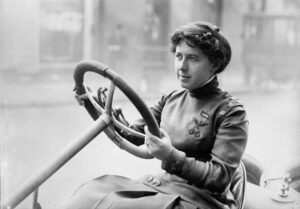
Photo by Shelagh Murphy

I can neither confirm nor deny that the following rewrite of “Onward Christian Soldiers” that’s being considered for the new hymnal (as part of an effort to make Trumpists feel more comfortable at church) has been leaked to me by a very secret source from the COB that I will refer to as Deep Quote Unquote.

Onward Christian Trumpists!
Marching as to war,
With the flag of MAGA
Going on before.
Trump the royal master,
Leads against the gays;
Forward into battle
In these latter days!

Chorus
Onward Christian Trumpists!
Marching as to war,
With the flag of MAGA
Going on before!

Jesus is our mascot,
Donald is our God!
We shun woke compassion,
And the kindness fraud.
Lib’ruls’ hearts now fail them,
At our burning cross.
Whites now lift your voices
Praise our righteous boss!

Chorus

A censoring army,
We seek books to ban.
Brothers we are treading
Steps trod by the Klan.
We are not divided,
All one body we:
One in ruthless hatred,
One in cruelty.

Chorus

Onward then ye people;
Our pronoun-free throng.
Blend with ours your anger,
In our wrathful song.
Stop those fools from voting
Who don’t love our Trump!
We should only ask “How high?”
When Donald tells us “Jump!”

Chorus


Clark G. Gilbert already has over a 50% chance of becoming Church president

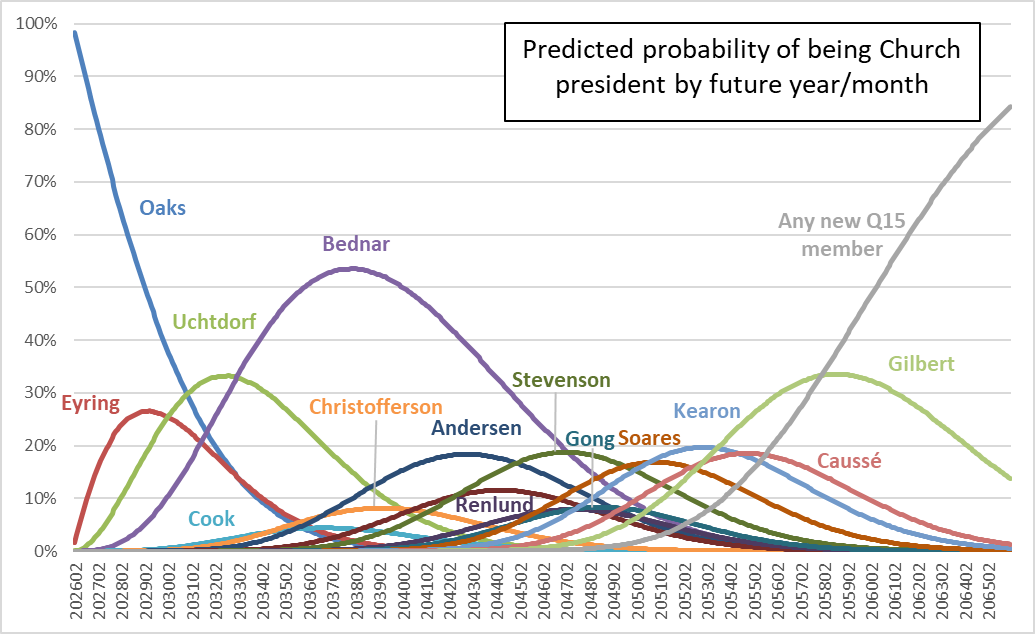
Dallin H. Oaks selected Clark G. Gilbert to fill the Q12 vacancy left by Jeffrey R. Holland’s passing in December. Needless to say, as a person on the fringe of the Church, I’m not happy with the choice of such a boundary-policing culture warrior. But of course nobody asked me! Elder Gilbert enters the quorum much like President Oaks did in that he’s far younger than any more senior member, so he already looks like a good bet to one day be Church president.

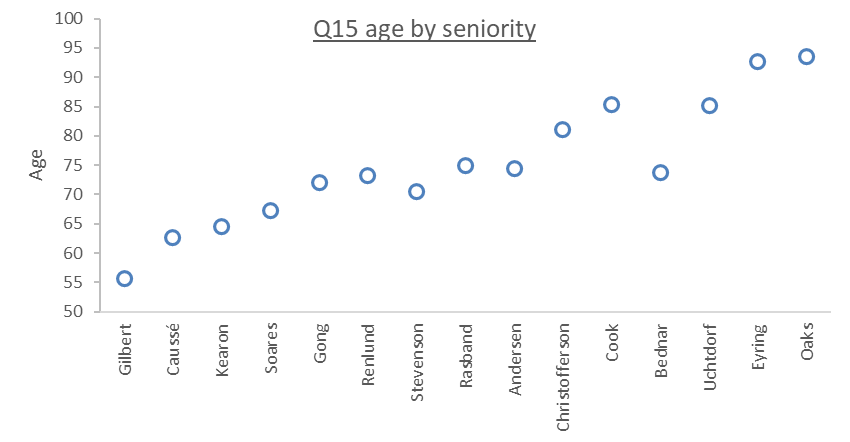
Here’s a look at the Q15 members’ ages. They’re ranked by increasing seniority.

Note that I cut off the zero to fifty years part of the graph at the bottom to better focus on the interesting part. The trend is obvious, and unsurprising, that the more senior members are older. The real outliers are David A. Bendar toward the right side, and then Elder Gilbert all the way to the left. It’s not a surprise that, as the most junior member, he’s the youngest. But he’s the youngest by seven years, an unusually large gap.

Here are monthly predicted probabilities for each Q15 member to be Church president, based on a mortality table from the Society of Actuaries.

Read More

Pickup Lines for Missionaries

In an interview last month, Dallin H. Oaks said the missionary age change he recently announced for women (from 19 to 18) was to encourage earlier marriage. He also said it’s fine for missionaries to meet their future spouse on their mission:

In the time that we have lowered the age for young men and for young women in the past, we’ve seen an increase in people who meet someone in the mission field and marry them, which is perfectly appropriate if it doesn’t start too early in their missionary service.

Photo by Vitaly Gariev on Unsplash

What are current and future missionaries to do, with this abrupt turnabout from the old “lock your heart” advice? Especially given that it’s almost Valentine’s Day, I thought it might be fun to help them out with some Mormon-themed pickup lines.

  • Did we just leave the Garden of Eden? Because I think I’ve fallen for you.
  • Are you protecting me from being spewed out of the mouth of God’s messenger for being lukewarm? Because I’m hot for you.
  • Is your workout routine from the Jaredites? Because your physique is tight like unto a dish.
  • Are you Russell M. Nelson? Because you’ve got me thinking celestial . . . marriage.
  • Were you just at the butcher? Because you look like a help meat for me.
  • Are you the serpent’s head? Because I’ve got a crush on you.
  • Are you the promised land? Because I’ve been seeking for you.
  • Is your name Ammon? Because your smile is so dis-arming.
  • Are you part of the 19th-century sacrament? Because being with you is intoxicating.
  • Can you help me out with a Liahona? Because I just got lost in your eyes.
  • Did you just come from the temple? Because you’re looking well endowed.

I’d love to hear your Mormon pickup lines in the comments too!

A Bible! A Bible! We have got a Bible, and now there can be more Bibles.

Photo by Priscilla Du Preez ?? on Unsplash

The Church announced last month that the latest edition of the Handbook encourages English-speaking members to read different versions of the Bible in addition to the KJV. The announcement includes the line  “Using multiple translations of the Bible is not new for the Church.” It isn’t surprising that they’d frame this change as not a change, given the Church’s never-ending insistence that it never changes, but of course it’s hilariously misleading given how devoted to being sola KJV-a we’ve been. But regardless of whether you think of this change as a big deal or just tidying things up around the edges, I did wonder at what changes in the Church we might see as a result of this new openness to more English Bible translations. I’m just a wild speculator, though, so I also recommend that if you want an actual historian’s take on how we got here and what the change might mean, you should read Matt Bowman’s post at BCC.

  • Doctrinal questions, big ones, will be raised by differences in translations. What will we say about the virgin birth when Isaiah 7:14 says that “the young woman is with child” (NRSVue) rather than “a virgin shall conceive”? Or how about our favorite proof texts about the Great Apostasy? When I was a missionary in the American South decades ago, we were taught to cite 2 Thessalonians 2:3 about a “falling away” as a clear reference to the loss of priesthood authority on the Earth. But what if it’s just a “rebellion” (NRSVue)? That sounds much less dramatic.

Read More

Nacle Notebook 2025: Funniest Comment

This post is my annual compilation of the funniest comments and parts of post I read on the Bloggernacle in 2025. Most of what I’m quoting is excerpted from longer comments or posts, so I’ve linked to the sources.

In case you haven’t read them yet, here are links to compilations for previous years: 2024 2023 2022 2021 2020 2019 2018 2017 2016 2015 2014 2013 2012 2011 2010 2009 2008.

J. Martinez, in her post “Of Ritas and Rhodas: Deciphering the Origins of the Women’s Temple Names” at Exponent II:

It seems Johnny Lingo might have had it wrong and it wasn’t cows that determined your worth but the number of verses your temple name earned in the scriptures. Suddenly my five verses weren’t looking too shabby.

Bishop Bill, in his post “The Book of ???????” (suggesting alternative names for The Book of Mormon) at W&T:

We need a name that puts Satan in his place, and doesn’t upset God.

Comments on Bishop Bill’s post:

The Book of the Savior, or The Church: Another Testament of Russell M Nelson and David A Bednar, with legal disclaimers by Dallin H Oaks

I think that to avoid giving a victory to Satan, we should refer to it as “The Book of He Who Shall Not Be Named.” That should attract converts, right?

How about some Jane Austin inspired titles.

Sense and Nonsense

Pride and Prophesy

Read More

Dieter F. Uchtdorf seems likely to become Church president

Jeffrey R. Holland passed away over the weekend. As you know if you’ve read ZD for any length of time, one analysis I’ve done repeatedly is looking at who among the Q15 might become Church president. President Holland’s death looks like it really clears the way for Dieter F. Uchtdorf to reach the top spot. I pointed out when I looked at the question about a decade ago that then-Elder Holland was by far the biggest obstacle to him, as they were very close in age (born about a month apart in 1940), but Uchdorf was two spots lower in the line of succession.

To look at the question more systematically, I updated the analysis I’ve done a number of times, using a mortality table from the Society of Actuaries and a bunch of random number draws to simulate possible orders in which the Q15 members die, and as a result who among them becomes Church president and for how long. If you’re interested in a more detailed description of the method, see my 2023 post, although note that I’m now doing the simulation with monthly steps rather than annual steps.

Here are the predicted probabilities by future year. These are actually straight from calculations on the mortality table, and don’t depend on the simulation.

Uchdorf’s curve is still dwarfed by Bednar’s, but for the first time since I started doing this type of analysis, there’s a period of time when he’s the single most likely member to be holding the top spot. Also, this analysis uses the same mortality table for every quorum member, so it doesn’t account for the evident frailty of both Presidents Oaks and Eyring.

Read More

Where in Africa is the Church growing faster or slower?

Last month, I wrote a post using Church-published membership data (generously scraped and shared by latter_data_saint on Reddit) to look at which US states have seen more or less growth—or even shrinkage—in the years before and since the pandemic began in early 2020. Today I’m looking at the same data for countries in Africa. I apologize for my slowness; I was never the most productive of bloggers, and the holiday season makes me even slower.

I prepared the data the same way as I did with the US data. You’ll remember, of course, the caveat about how these are reported membership counts, so active membership is likely to be quite a bit lower. Also, the growth rate has been so much faster in Africa than in the US that I used different bin boundaries for the growth colors to be able to show some differences. Here’s the pre-pandemic growth rate by country.

Read More

Increase, decrease; To-may-to, to-mah-to

The Church announced a few days ago that the Saturday night session of General Conference will be dropped. You probably remember that this was a Nelson-era change from 2021 that was promptly reversed a few months later. I guess only time will tell whether the change sticks this time. I’m guessing it will, because it does kind of suggest that Dallin H. Oaks might have pushed for the change initially, and much like how Russell M. Nelson clearly filed away his distaste for the term “Mormon” back in 1990 after being overruled by Gordon B. Hinckley, he filed this idea away when President Nelson changed course and reinstated it. Well, either that or he spun the Saturday Night Session Selector and a helpful angel who was passing by carefully got it stuck on “no session.”

Photo by engin akyurt on Unsplash

What makes me laugh about the announcement is that it’s so terse (30 words, nine of which are used just in spelling out the full name of the Church), but it comes with a headline that frames it as an increase: “Church Increases Focus on Four Daytime Sessions of General Conference.” Only the subtitle admits, “Saturday evening session will no longer be held.” This sounds to me a lot like the double-speak marketing nonsense that comes out of large corporations. “Congratulations! We’re expanding the benefits of our product or service to include this tiny irrelevant thing!” Then, buried in the footnotes, “We’re also ending this key feature that everyone loved.” (This isn’t to suggest that everyone loved the Saturday night session. Just that the doublespeak is similar.)

This framing inspires me to think of other changes the Church has made or could make, and how they could be reframed using similar doublespeak.

2020: Ensign and New Era archives are available on the Church website going back to 1971! (Both magazines are to be discontinued under their current names.)

Read More

Where in the US is the Church growing vs. shrinking?

For over a decade, the Church has published membership counts by country (and by US state, and Canadian province, and counts of units, and other various and sundry items) on its website. Over at the Mormon subreddit, a generous person who goes by the charming name latter_data_saint has scraped all the past data from the Internet Archive and made it available for perusal by any interested parties. And you can bet I’m an interested party, so I’ve taken a look.

In this post, I just wanted to look at US states, at which ones have membership growing more or less quickly, or even shrinking. From latter_data_saint’s data, I pulled out three data points for each state (and Washington, DC): the oldest value, the last value before the pandemic (which turned out to be late 2019), and the most recent value. Then I used these to calculate for each state the annual growth rate pre-pandemic (2012-2019) and post-pandemic (2019-2025). Of course you’ll want to keep in mind the usual caveats about how stated Church membership is going to be far higher than actual counts of posteriors in pews.

Warning: You might want to skip this paragraph if too much math makes your eyes glaze over. I got the annual growth rate from the total growth rate by just taking the yth root of one plus the total growth rate, where y is the number of years apart between first and last value, and subtracting one. For example, if the total growth rate were 10% for a particular state, and the values were seven years apart, then I would take the 7th root of 1+10% (or in other words, raise 1+10% to the power of 1/7), which works out to 1.014, so subtracting one gives a 1.4% annual growth rate. This means 1.4% annual growth over seven years gives 10% total growth: (1+1.4%)^7 = 1.10.

Here’s pre-pandemic growth.

California was alone in actually having a negative growth rate over the period. Texas and North Dakota had the fastest growth, and there was also some relatively strong growth in the old Confederacy, other than Mississippi. (Note that I excluded two states and DC for having a small number of members.)

Read More

The Church will more likely than not have its first non-American president since John Taylor by 2046

Gérald Caussé was called into the Q12 on Thursday to fill the vacancy left by Russell M. Nelson’s passing. Elder Caussé was born in France, making him the third called Q12 member in a row to have been born outside the US (following Ulisses Soares and Patrick Kearon). The Church has only had one president born outside the US, John Taylor, who was born in England in 1808. With this group of three, especially following after German-born Dieter F. Uchtdorf, the question is how soon we might see another.

To answer this question, I ran a little simulation like I have a bunch of times before (most recently in this post). I performed 10,000 random number draws for each Q15 member, and compared them to survival probabilities for each future month based on a mortality table from the Society of Actuaries to get each man’s 10,000 estimated remaining lifespans. Then, using the established rule that the senior living Q15 member becomes president when the president dies, I found how likely it was (i.e., in how many simulated futures) for each man to become Church president. In this simulation, I added an extra check, which is in how many simulations a non-American-born Q15 member became president, and when in those simulations it happened.

This first graph shows the result for this last question: the probability of at least one non-American-born Q15 member becoming president by each date in the future. (In case it isn’t clear, the dates are in YYYYMM format.) There’s an early probability bump in the 2030s, when Elder Uchtdorf has a good probability (and as I’ve noted before, probably better than this analysis suggests, given Jeffrey R. Holland’s ill health), and then a later increase in the 2040s when the three most recently called members have a good chance, especially as a group and given they’re in seniority order right after each other. As you can see, I’ve noted the month when the probability crosses over 50%, near the end of 2046. Note that the simulation goes out 60 years even though the graph only shows the first 30.

Read More

A Heretic Reviews General Conference, October 2025

Fastest hymn: In Hymns of Praise, Sunday afternoon
Slowest hymn: None stood out.
Best hymn: I really enjoyed hearing good choirs sing hymns that are often just sung as congregational hymns in the middle of a session. High on the Mountain Top, How Firm a Foundation, and Come, Come, Ye Saints were all excellent.
Worst hymn: Let’s please not sing the self-congratulatory We Thank Thee, O God, for a Prophet anymore.
Hymn so bouncy that I’m surprised it’s in our hymnbook or allowed at Conference: Standing on the Promises. Note that this isn’t a complaint; I liked the hymn.

Longest prayer: 146 seconds, I. Raymond Egbo, Saturday evening benediction
Shortest prayer: 42 seconds, Christophe G. Giraud-Carrier, Saturday afternoon invocation
Worst prayer: I typically don’t comment on the content of prayers, but I just had to mention Jörg Klebingat’s invocation Saturday evening, where he not only had to remind God of President Oaks’s full name, Dallin Harris Oaks (as though God might get mixed up about which Dallin H. Oaks he was praying for), but also repeated the ridiculous condescending trope that behind every good man is an even better woman. Riiiight. That’s why they can’t be ordained.

Longest talk: 1974 words, D. Todd Christofferson
Shortest talk: 1242 words, Matthew S. Holland

Best visual aids: I enjoyed Gerrit W. Gong’s pictures of him visiting church groups in different places. I especially liked this one where he’s shaking hands with a line of people, including a young man who not only isn’t wearing a white shirt, but is wearing a black shirt and a white tie! I appreciate the young man’s subversion of Mormon norms.

Read More

Nine things I’m curious to see about the Oaks presidency

Image source: Wikimedia. This file is licensed under the Creative Commons Attribution-Share Alike 4.0 International license.
  • Who will he choose as his counselors? Will Henry B. Eyring be given a break in his declining years, or is he in for life? Will President Oaks choose some fellow lawyers (step right up, Elders Cook and Christofferson!) or avoid them? More importantly, will he choose some fellow hardliners, or select at least one more compassionate voice to advise him? I think this will strongly signal the direction he wants to steer the Church. Contrast a presidency with Elders Bednar and Andersen as counselors versus one with Elders Uchtodorf (unlikely, I know, but a guy can dream!) and Gong, for example. Or what if he called Elders Soares and Kearon, not only from the junior end, but also not Americans? How cool would that be?
  • Perhaps an even bigger question is who he’ll call to round out the Q12. I do a bad job of keeping track of the likely candidates, but of course there are more fundamentalist and more liberal possibilities. (If you’re interested, here’s a W&T post where a guest poster looks at possibilities and suggests it will be Gérald Caussé.) Again, his pick will signal where he sees the Church going, and although I fear he’d prefer a hardliner, I was very pleasantly surprised by President Nelson’s selection of Patrick Kearon, so I guess you never know.

Read More

Church President Probabilities with Dallin H. Oaks in the Top Spot

As you no doubt have heard, Russell M. Nelson passed away over the weekend, at the age of 101. A friend messaged me quickly to ask what this meant for probabilities of reaching the top spot for all the other Q15 members, so I thought I’d update the analysis I’ve done periodically.

This graph shows future probabilities for each Q15 member. As when I’ve done this before, I used a mortality table produced by the Society of Actuaries to create it. For details on the method, see the “Method” section of my 2023 post on this question. One update I continued from my 2024 post is to do the calculations for each month in the future rather than for each year. In addition, I fixed an error that DaveW pointed out last year where I was cutting off the calculations too early for the younger Q15 members by only going out 30 years, so this time I went out 60 years even though the graph only shows 30 because that’s the period where most of the action is.


Read More

GA Preferences

Image credit: josephvm on Pixabay

General Conference is a couple of weeks away. We’ll get to hear a lot about the covenant path and the One True Church and certainly some mentions of the Most Correct of Any Book. But we also might get to hear a few tidbits about GAs’ idiosyncratic preferences. For example, Dallin H. Oaks thinks it’s very important that we take the sacrament with our right hands. And someone (I’m guessing Russell M. Nelson) is running a campaign to get temples rebranded as “houses of the Lord.”

How much time or effort should we spend trying to tease out these sometimes idiosyncratic GA preferences from the core of the gospel, things like the Two Great Commandments, the atonement and so forth? I feel like I’ve spent far too much mental energy in my life on this task. I thought it was worthwhile, though, because I figured, and certainly heard lots of people say, that you could just ignore those tangential personal preferences of individual GAs and just hold to the core of the gospel.

But here’s my problem: It’s often unclear where one ends and the other begins. Read More

How the Church could change

How can the Church change? This is often a question on my mind, as there are so many things I’d like to see changed, such as ordaining women, for example. To say the Church is resistant to change would be an understatement. And even more so, it resists the public perception that it could be changed by outside pressure. But of course it does change all the time. These changes are always framed as just new ways of doing the same fundamental things, though. As Steve Taysom said so well in his biography of Joseph F. Smith,

Successful religions, meaning those that are historically persistent, find ways to make necessary changes to remain viable within a given cultural and historical context while simultaneously explaining away the changes as nonexistent, unimportant, or as epiphenomena that are changes in appearance only, and which are actually in service of a larger, unchanging phenomenon.

Image by Augusto Ordóñez from Pixabay. This guy looks younger than most GAs, but I love his look of annoyance. I’m imagining him reading this post and saying “No, Ziff. We never change.”

Reading articles for my last post on modesty rhetoric, I was pleasantly surprised that several of them waved away past teachings on modesty as being 100% about clothing. But I was also kind of amazed that they so obviously elided where those past teachings came from. Here’s an example from a 2019 New Era article:

When you hear the word modesty, what’s the first thing that pops into your head? Probably a list of clothing “do’s and don’ts” that you’ve been taught since you were little. But let’s try thinking of modesty in a different way.

I love the moving on to think of modesty in a different way, but I also think it’s absurd to not admit where the teachings “since you were little” came from, namely Church leaders and manuals and magazines and rhetoric in general.

So maybe this is how the Church can change: by pretending that its previous teachings that are now being discarded didn’t happen, or somehow came from some other source.

Read More

Modesty rhetoric in Church magazines has declined since the mid-2010s

Over a decade ago (have I really been blogging that long?), I wrote a couple of posts (2011, 2014) where I counted up articles in Church magazines that talked about modesty in dress. Briefly, I found that modesty rhetoric had really ramped up since the turn of the millennium, and not surprisingly, was aimed more at women and girls than at men and boys.

In this post, I’m updating my 2014 post to include ten more years of data. I used the same scoring method that I did in 2014. (The gist is that I used Google to search for articles from magazines on the Church website that used forms of the word modest, and then scored each article for roughly what fraction was about modesty in dress, and also whether it was targeted at women/girls, men/boys, or both.) This graph shows what I found.

The bottom line, like I said in the title, is that there’s been a dramatic decrease since about the time I wrote my last post. This has been particularly noticeable for teen girls, who as far as I can tell haven’t been talked to about modesty since before the pandemic. This trend seems consistent with the Church’s introduction in 2022 of a new For the Strength of Youth pamphlet that is generally less prescriptive and more principles-based. And I noticed in reading the articles that do talk about modesty that they seem much more matter-of-fact and less frantic than previous ones. For example, here’s a good one from the New Era in 2019.

Adult women, on the other hand, have seen a modest 😉 increase in rhetoric aimed at them in the past few years. This also seems consistent with increased focus from the Church on the importance of wearing temple garments, with for example J. Anette Dennis and Dallin H. Oaks talking about it in Conference last year. Of course this focus is mostly on women, as women’s garments are less compatible with commonly available women’s clothes than men’s are with men’s clothes, and in a patriarchal church like ours, women’s dress will always be seen as more of an issue than men’s.

So, two cheers for the results, for teen girls and children in general anyway. It’s definitely a positive step when we can back off body shaming young people who are often the most psychologically vulnerable among us. And for the adult women, I can hope that the new sleeveless-leaning ones will maybe reduce the friction between garments and typical clothing styles a little, and perhaps encourage GAs to worry about something more substantial in their Conference talks.

Why do Mormons love Jane Austen?

Wait, do Mormons love Jane Austen? I grew up in Utah Valley, surrounded by lots of other Mormons, so it was sometimes hard for me to tell what cultural things were particular to Mormons versus common among Americans (or even larger groups). That being said, I did always feel like there was a particular love of all things Jane Austen among people around me. I didn’t participate much in it. I didn’t read any of her books, although I did watch some movie adaptations, with my favorite being the excellent 1995 Sense and Sensibility that Emma Thompson both wrote and starred in.

But getting back to the question, I was honestly a bit surprised when I looked Jane Austen up on Google Trends and found that not only did Utah rank high, it ranked number one! And Idaho was number two. So that seems like pretty good evidence that I was right that Mormons (at least American Mormons) might have a thing for Jane Austen.


Read More

Hi hungry, I’m Dad: Dad jokes for Father’s Day

Photo by Jennifer Kalenberg on Unsplash

To celebrate Father’s Day, here are a few of my Mormon-themed (or at least church-related) dad jokes. Please recall as you read that when your eyes roll, they are momentarily pointed toward heaven. You’re welcome. (Note: In case you’re curious, I’m the author of all of these jokes, at least as far as I know. But given how joke-telling is a social activity, and they get written and re-written as they’re passed around, it’s entirely possible that I’ve unconsciously borrowed from other sources.)

Q: If Isaiah lived today, what would he call his TV show where he lamented people’s obsession with clothes?
A: Everybody Loves Raiment.

Read More

Mormon Product Ideas

As someone who’s still blogging in 2025, I realize that I’m several generations behind in how things are done online nowadays. I was thinking of moving on to become a Mormon influencer on TikChat or InstaSnap or somesuch, and was wondering about the contraptions I might get to test or endorse. Here are some of my ideas.

Image credit: Pascal Lapalme on Openclipart

  • Lust monitor. These are a pair of smart glasses which constantly check what you’re is looking at, with special focus on other’s body parts. If you look at any part of another person’s body below the neck for more than one second (time may be adjustable), the glasses will deliver a small shock to your eyeballs. It’s not quite plucking out the offending eye, but it’s a reminder of the possibility. Note: Not recommended for medical professionals or massage therapists.
  • Hidden inflatable seat cushion. For all those times you’re stuck sitting on a hard chair in second hour, or sacrament meeting, or any meeting really! Your fellow members might give you the side eye if you openly pull out a cushioned stadium seat. The pioneers walked across the plains, and you can’t even manage to sit on a hard chair for an hour? But with this subtle inflatable cushion that slips easily into your skirt or pants, you can quietly fill it and have more cushion for the tush-in’. Bonus points if it doesn’t sound like you’re passing gas when you let the air out.

Read More

Why do women give better conference talks than men?

Tamara W. Runia, who’s serving as First Counselor in the YW General Presidency, gave by far my favorite talk of April’s General Conference. I also enjoyed her previous talk in 2023. She’s dueling with Patrick Kearon in my head for my current favorite speaker. And in the previous General RS Presidency, I loved Conference talks from both counselors, Sharon Eubank and Reyna I. Aburto. It occurred to me that there are more women giving strikingly good Conference talks (at least in my view) than there are men, perhaps not in absolute numbers, but certainly as a percentage of the total numbers of women and men giving talks.

Why might this be so? I’ve come up with a couple of lists of reasons. The first is a list of hows, that outline the characteristics of their talks where I feel like they outdo men. The second is a list of whys. These are my guesses about what the causes might be behind the hows that make their talks different.

How

  • Women speakers are less often doctrinaire than men are, less prone to try to lay down the law of This Is The Way Things Are. They seem more often to frame the advice they give as advice, rather than as commandment.
  • Women seem more often concerned with interpersonal connection, and less concerned with hierarchy, even Church hierarchy. Some men seem deeply concerned with members’ submission to Church hierarchy, and to them in particular. They are the Oracles of the Most High God, and they are darn well going to remind us of it. I find this extremely grating.
  • It’s my impression that women are more likely to address people who are out of the Church’s main target demographic, which seems to be young couples who are raising young children. They’re more open to acknowledging that people might be unmarried or widowed or even gay, or that they might be lonely or depressed.
  • Women are less prone to repeating their stories or even virtually entire talks, as some men do.

Read More